Ever wonder why you enter a store for milk and leave with a full cart? Supermarkets are high-tech psychological labs designed to influence your behavior. Every detail is engineered to bypass your logic and trigger impulse buys.
In 2026, as supermarkets become even more data-driven, understanding these triggers is the only way to protect your budget. Here is the secret psychology of grocery shopping—and how ListKart gives you the edge to stay in control.
1 The "Gruen Effect": Why Stores Disorient You
Named after architect Victor Gruen, this effect refers to the deliberate confusing of a shopper's spatial sense. Giant supermarkets are often intentionally disorienting. Why? Because the longer it takes you to find what you need, the more "discovery items" you pass.
The ListKart Shield: Using our Smart Category sorting, you can navigate the store with surgical precision. ListKart organizes your items by aisle type, meaning you spend less time drifting and more time checking items off.
🧠 Psych Tip:
Supermarkets often place essential perishables (milk, bread, eggs) at the far corners of the store, forcing you to walk through the entire layout just to get the basics.
2 Eye-Level is Buy-Level
Brands pay heavily for "slotting fees"—premium space on shelves. The items at your eye level are almost always the most expensive. The cheaper, bulk options are usually hidden on the bottom shelf, while items for children are placed at their eye-level to trigger "pester power."
The ListKart Shield: By sticking to a digital list with the Budget Tracker, your eyes are trained on your goal, not the shelf "highlights." You know exactly what you came for, making it easier to ignore the eye-level markups.
3 The Sensory Overload Trap
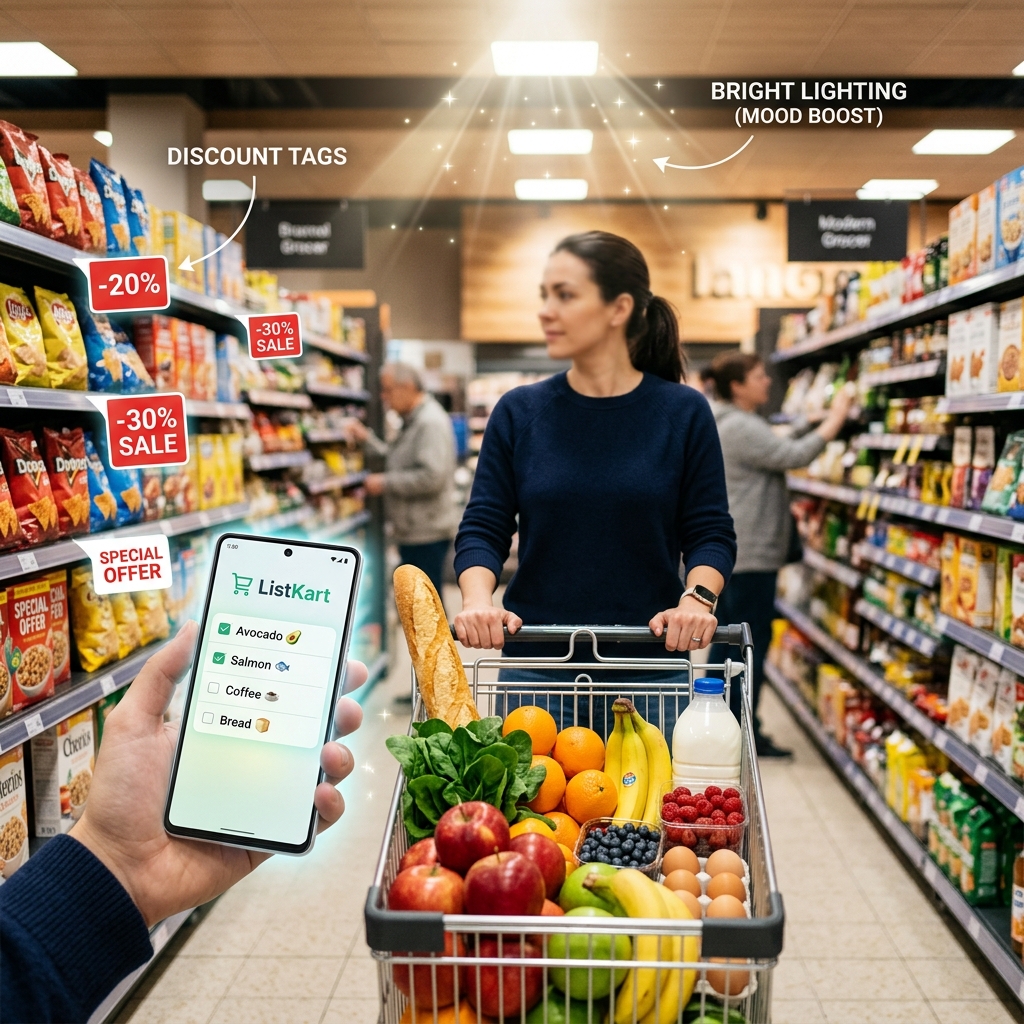
Stores use the smell of fresh rotisserie chicken or fresh bread to trigger appetite. High-quality lighting makes produce look "fresher" than it is. These sensory inputs lower your inhibitions and make everything look desirable.
The ListKart Shield: Our clean, clutter-free interface provides a visual anchor. When the store tries to overwhelm your senses, focusing on your list keeps your brain in "logic mode" rather than "emotional mode."
4 The False Scarcity and "End-Cap" Lure
Items placed at the ends of aisles (end-caps) suggest they are on sale, even if they aren't. Combined with signs like "Max 3 per customer," stores create a feeling of scarcity that makes you buy items you never intended to.
The ListKart Shield: With real-time Family Sync, your partner can act as a second pair of eyes. If you see a "deal" on an end-cap, a quick check of your shared list will remind you if you already have enough at home.
5 The Checkout Labyrinth
The checkout lane is where your "decision fatigue" is exploited. After a long shop, your willpower is lower. This is why the checkout is packed with small, bright, high-margin impulse buys like candy, gum, and magazines.
The ListKart Shield: The satisfying feeling of "checking off" the last item on your ListKart list provides a dopamine hit that signals the end of your shopping journey. This mental closure makes you less likely to "treat yourself" at the checkout with unplanned items.
Don't let them win.
Master your shopping habits with the smartest, 100% free shopping list app of 2026.
Get ListKart – Protect Your Budget